The Neuroscience of Sleep Stages: NREM vs REM
Understand the difference between NREM and REM sleep stages, how they repair your body and mind, and why sleep quality matters more than duration.
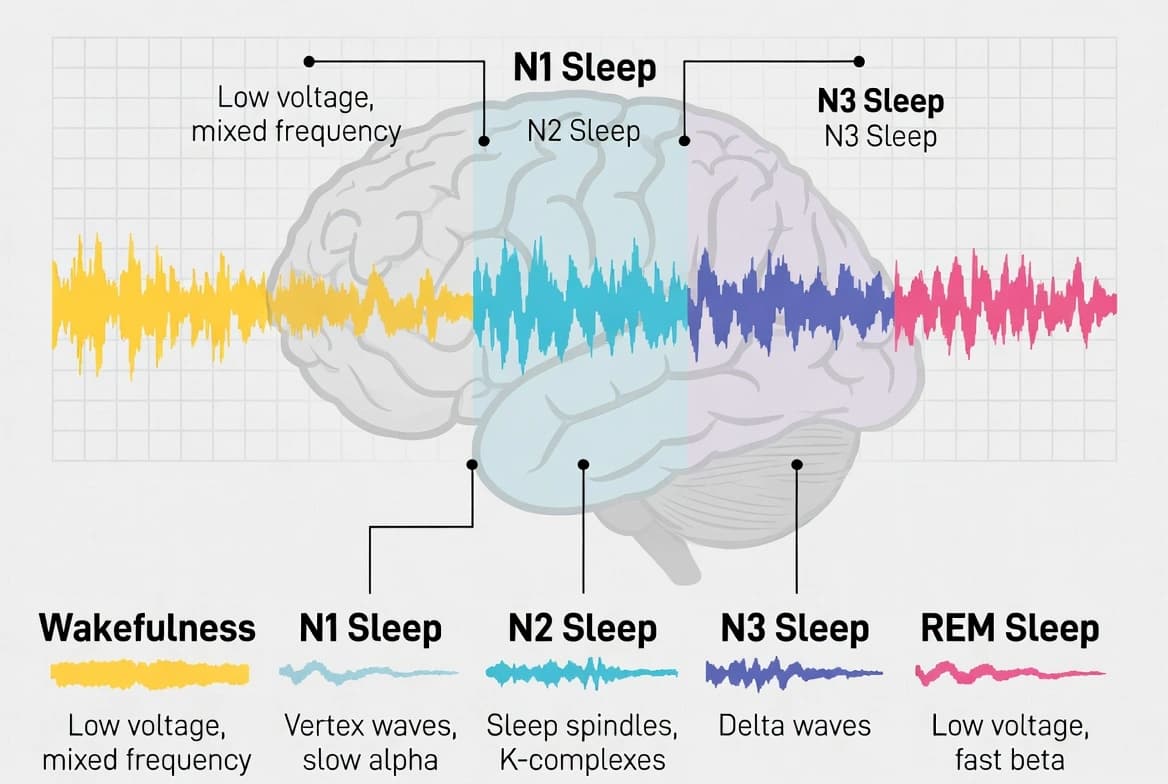
Sleep is not a single state. It is a carefully structured neurological cycle where your brain and body move through distinct stages, each performing specific repair, maintenance, and optimization functions.
When people say they slept "8 hours," what really matters is how much time they spent in each stage, not just the total duration.
Understanding the difference between NREM and REM sleep explains why fragmented sleep leaves you exhausted—even if the clock says you slept enough.
The Two Major Categories of Sleep
Sleep is divided into two primary types:
NREM (Non-Rapid Eye Movement) Physical repair and nervous system recovery
REM (Rapid Eye Movement) Mental repair, emotional processing, and memory integration
These alternate in cycles lasting about 90 minutes, repeating 4–6 times per night.
Early cycles prioritize physical repair. Later cycles prioritize mental restoration.
Both are essential.
NREM Sleep: Physical Restoration and Nervous System Reset
NREM makes up about 75–80% of total sleep and consists of three stages.
Stage 1: Transition Phase
This is the lightest sleep stage.
Brain activity slows slightly, muscles relax, and awareness fades.
This stage usually lasts only a few minutes.
If you are easily awakened, you are likely in Stage 1.
Stage 2: Stabilization Phase
This stage represents about 50% of total sleep.
The brain begins producing sleep-specific electrical patterns called:
- sleep spindles
- K-complexes
These protect sleep by reducing sensitivity to external stimuli.
Heart rate slows. Body temperature drops.
The nervous system is preparing for deeper recovery.
Stage 3: Deep Sleep (Slow-Wave Sleep)
This is the most physically restorative stage.
Brain waves slow dramatically into delta waves.
During deep sleep:
- growth hormone is released
- muscles repair
- immune system strengthens
- energy stores replenish
This is why sleep deprivation weakens immunity and slows physical recovery.
Deep sleep is hardest to wake from—and most essential.
REM Sleep: Mental Restoration and Brain Optimization
REM sleep usually begins about 90 minutes after falling asleep.
During REM:
- brain activity becomes highly active
- dreaming occurs
- emotional processing happens
- memory is reorganized
Interestingly, the body becomes temporarily paralyzed to prevent acting out dreams.
This protects you while your brain is highly active.
Why REM Sleep Matters for Mental Health
REM sleep regulates emotional balance.
Without enough REM sleep:
- stress tolerance decreases
- emotional reactions intensify
- mood stability declines
This explains why poor sleep increases anxiety and irritability.
REM sleep stabilizes the emotional brain.
The Sleep Cycle: A Nightly Neurological Pattern
A typical cycle looks like this:
Stage 1 → Stage 2 → Stage 3 → back to Stage 2 → REM
Then the cycle repeats.
Early night:
More deep sleep Less REM
Late night:
Less deep sleep More REM
This is why cutting sleep short harms mental function more than physical recovery.
The final hours are critical for brain optimization.
What Happens When Sleep Is Interrupted
Fragmented sleep prevents proper stage progression.
Even if total sleep time seems adequate, interruptions reduce:
- deep sleep duration
- REM completion
- nervous system recovery
This leads to:
- brain fog
- fatigue
- reduced learning ability
- emotional instability
Consistency protects sleep architecture.
Sleep Stages and Modern Lifestyle
Several modern factors reduce deep and REM sleep:
- late-night screen exposure
- stress and cortisol elevation
- irregular sleep schedules
- caffeine late in the day
- shift work
These disrupt the brain's natural progression.
Sleep becomes lighter and less restorative.
How to Protect Your Sleep Cycles
Simple habits significantly improve sleep stage quality:
Maintain consistent sleep times The brain organizes sleep stages based on routine.
Avoid caffeine within 8–10 hours of sleep
Reduce light exposure before bed
Sleep in a cool, dark environment
Allow enough total sleep time (7–9 hours)
Sleep cycles cannot compress efficiently into short durations.
Why Sleep Is a Neurological Process, Not Just Rest
Sleep is an active biological process.
The brain is reorganizing itself.
The body is rebuilding itself.
The nervous system is stabilizing itself.
NREM restores the body. REM restores the mind.
Both are required to function at full capacity.