Yoga Nidra for Complete Sleep Relaxation
Learn the complete Yoga Nidra technique for deep nervous system relaxation, faster sleep onset, and improved sleep quality through guided meditation.
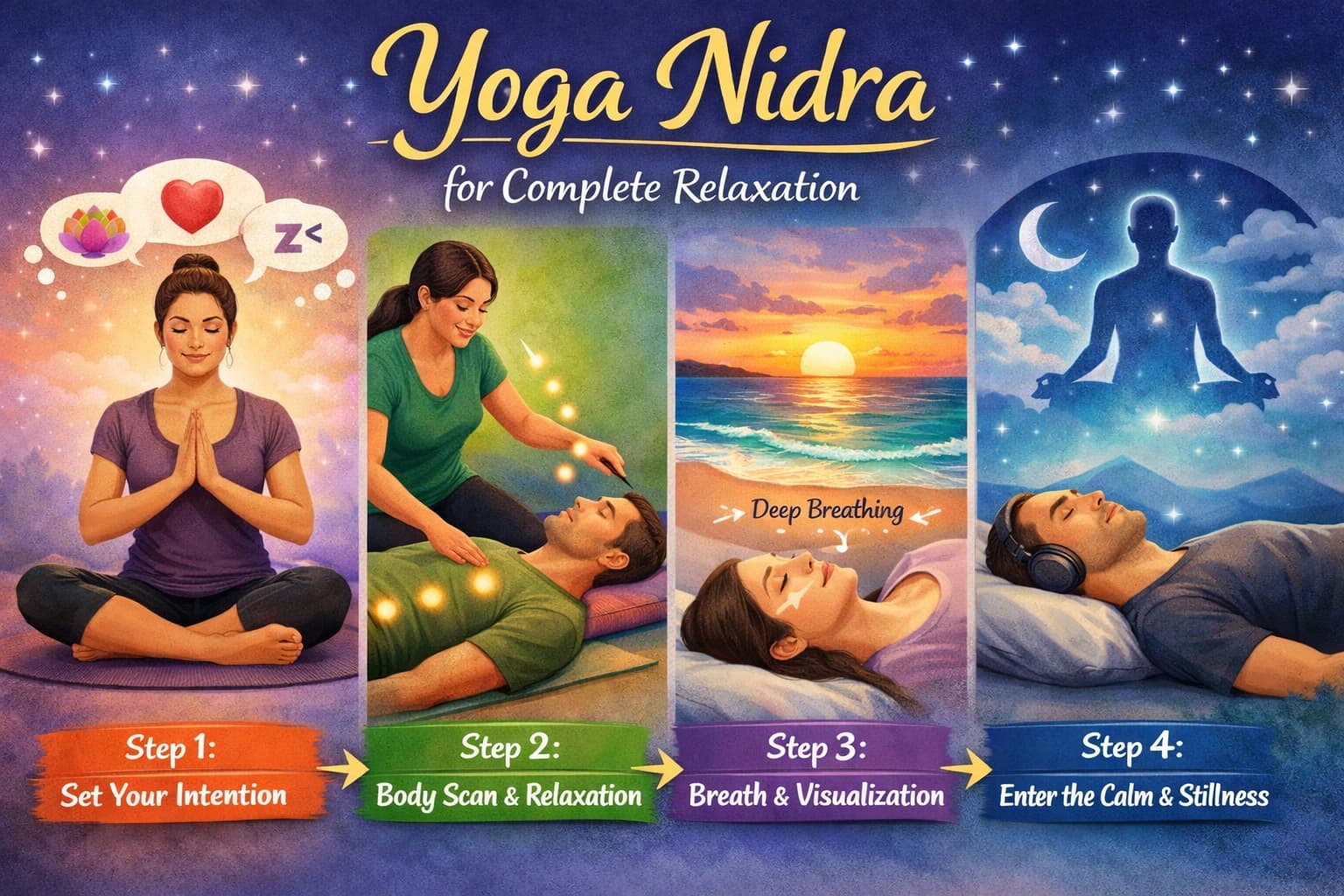
Most people try to improve sleep by focusing only on the moment they go to bed. They turn off lights, put their phone away, and hope their body will cooperate. But sleep is not something you can force. It happens when your nervous system feels safe enough to let go.
Yoga Nidra—often called "yogic sleep"—is one of the most effective methods ever developed to guide the body into deep relaxation. It does not require flexibility, strength, or prior yoga experience. It requires only stillness and awareness.
Unlike physical yoga, Yoga Nidra works directly on the nervous system. It systematically slows brain activity, reduces stress hormones, and prepares the body for restorative sleep.
Many people who practice Yoga Nidra regularly report falling asleep faster, sleeping deeper, and waking up with clearer mental energy.
This is not just relaxation. It is nervous system training.
What Is Yoga Nidra?
Yoga Nidra is a guided relaxation technique performed while lying still, usually on your back. The goal is to bring your body into a sleep-like state while keeping a small level of awareness.
In this state:
- muscles fully relax
- breathing slows
- heart rate decreases
- brain waves shift toward sleep patterns
You are not forcing sleep. You are removing the barriers that prevent it.
This state exists between wakefulness and sleep—the exact threshold where natural sleep begins.
Practicing Yoga Nidra trains your brain to enter this state more easily at night.
Why Modern Nervous Systems Struggle to Relax
The human nervous system evolved for survival, not constant stimulation. Today, stress, screens, and mental overload keep the nervous system in a state of alertness long after the day ends.
Even when your body is physically tired, your nervous system may remain active.
This leads to:
- difficulty falling asleep
- shallow sleep
- frequent awakenings
- racing thoughts
Yoga Nidra directly addresses this by activating the parasympathetic nervous system, also known as the "rest and recovery" system.
This is the system required for sleep.
The Science Behind Yoga Nidra and Sleep
During Yoga Nidra, the brain shifts from fast, alert beta waves into slower alpha and theta waves.
These are the same brain wave patterns present during early sleep stages.
This produces several effects:
- cortisol (stress hormone) decreases
- muscle tension releases
- breathing becomes slower and deeper
- mental activity quiets
This neurological shift prepares the brain for deep sleep.
Practicing regularly makes it easier to enter sleep naturally.
Benefits of Yoga Nidra for Sleep and Recovery
Yoga Nidra improves sleep by addressing both physical and neurological causes of insomnia.
Benefits include:
Faster sleep onset Your nervous system learns how to transition into rest.
Deeper sleep quality The body enters restorative stages more efficiently.
Reduced nighttime awakenings The nervous system becomes more stable.
Lower stress and anxiety Mental tension decreases.
Improved emotional regulation The brain processes stress more effectively.
Better daytime focus and energy
Yoga Nidra does not sedate the brain. It restores its natural rhythm.
When to Practice Yoga Nidra
Yoga Nidra can be practiced:
- before bedtime
- during evening wind-down
- after stressful days
- during naps
- anytime deep relaxation is needed
Even practicing during the day improves nighttime sleep.
Consistency matters more than timing.
Preparing for Yoga Nidra
Before beginning, create a comfortable environment.
Choose a quiet space
Dim the lights
Wear comfortable clothing
Use a mat, bed, or soft surface
Keep your body warm with a blanket
The goal is complete physical comfort so the body does not need to adjust.
Once still, movement should be minimal.
The Complete Step-by-Step Yoga Nidra Process
Below is a full sequence you can follow.
Step 1: Corpse Pose (Savasana)
Lie flat on your back.
Arms at your sides, slightly away from your body.
Palms facing upward.
Legs relaxed and slightly apart.
Allow your feet to fall outward naturally.
Close your eyes.
This position removes muscular effort completely.
It allows gravity to support your body.
Benefits:
- releases spinal tension
- reduces muscle activity
- improves circulation
- signals the nervous system to relax
This is the foundation of Yoga Nidra.
Remain completely still.
Step 2: Conscious Breathing
Bring attention to your breathing.
Do not force it.
Simply observe it.
Feel the air entering your nose.
Feel the air leaving your nose.
Allow each breath to become slower naturally.
After several breaths, begin slightly deepening inhalations.
Then allow slow, controlled exhalations.
Exhalation activates relaxation.
Benefits:
- reduces heart rate
- lowers stress hormones
- activates parasympathetic nervous system
Breathing is the fastest way to calm the nervous system.
Stay here for several minutes.
Step 3: Body Awareness Rotation
Now begin bringing attention to individual body parts.
Move slowly through this sequence mentally:
Right hand Right forearm Right upper arm Left hand Left forearm Left upper arm
Then move to:
Right foot Right calf Right thigh
Left foot Left calf Left thigh
Then:
Lower back Upper back Shoulders
Neck Face Forehead
Do not move physically.
Only observe.
This process disconnects muscular tension from the brain.
Benefits:
- releases hidden tension
- improves nervous system control
- reduces subconscious muscle contraction
This stage deeply relaxes the body.
Step 4: Progressive Muscle Release
Gently tighten a muscle group briefly.
Then release.
Start with feet.
Then legs.
Then hands.
Then shoulders.
Then face.
Release completely.
This contrast helps the brain recognize relaxation more clearly.
Benefits:
- reduces physical tension
- improves relaxation awareness
After releasing, remain completely still.
Step 5: Breath Counting
Begin counting breaths backward.
For example:
Inhale Exhale — count 10
Inhale Exhale — count 9
Continue downward.
If your mind wanders, restart.
This keeps your awareness calm and focused.
Benefits:
- prevents racing thoughts
- stabilizes attention
- prepares brain for sleep transition
Mental stillness begins here.
Step 6: Visualization
Imagine a calm, safe environment.
Examples:
A quiet beach A dark, cool room A peaceful forest
Imagine details:
Temperature Sounds Lighting
This engages sensory areas of the brain associated with safety.
Safety allows sleep.
Benefits:
- reduces anxiety
- stabilizes emotional centers
The nervous system follows mental signals.
Step 7: Complete Stillness
Now stop all mental effort.
Allow breathing to continue naturally.
Allow the body to remain heavy.
Allow thoughts to pass without engagement.
At this stage, sleep may occur naturally.
This is the Yoga Nidra state.
Even if you remain aware, your nervous system enters deep recovery.
Why Yoga Nidra Is Different From Normal Relaxation
Most relaxation methods only affect muscles.
Yoga Nidra affects the nervous system directly.
It trains the brain to exit stress mode.
Over time, this ability becomes automatic.
You begin falling asleep faster without effort.
How Yoga Nidra Improves Insomnia
Insomnia often results from nervous system hyperactivity.
The body remains alert even when tired.
Yoga Nidra reverses this.
It teaches the nervous system that rest is safe.
This removes the biological resistance to sleep.
Sleep becomes natural again.
How Long Should You Practice?
Beginners can start with:
10–20 minutes
With experience, sessions may last:
30–45 minutes
Even short sessions are effective.
Consistency produces the strongest results.
Why Many People Accidentally Fall Asleep During Yoga Nidra
This is normal.
It means the nervous system reached deep relaxation.
Over time, you may remain aware longer.
Both outcomes are beneficial.
The goal is nervous system recovery.
Common Mistakes to Avoid
Trying too hard
Relaxation cannot be forced.
Uncomfortable environment
Physical discomfort prevents relaxation.
Practicing with distractions
Noise and interruptions reduce effectiveness.
Expecting instant results
Nervous system training takes repetition.
Improvement becomes noticeable over time.
How Long Until Results Appear
Some people notice improvement immediately.
For others, it may take several weeks.
Changes often include:
- faster sleep onset
- reduced anxiety
- deeper sleep
- improved daytime energy
The nervous system learns through repetition.
Why Yoga Nidra Is Especially Powerful in Modern Life
Modern life keeps the nervous system constantly stimulated.
Even rest time includes screens and mental input.
Yoga Nidra removes stimulation completely.
This allows true neurological recovery.
Few other techniques achieve this as effectively.
Combining Yoga Nidra With Your Evening Routine
Yoga Nidra works best when combined with other sleep habits:
Low lighting in the evening Consistent sleep schedule Reduced screen exposure Cool sleeping environment
These reinforce your nervous system's sleep signals.
Long-Term Benefits Beyond Sleep
Yoga Nidra improves more than sleep.
It enhances overall nervous system stability.
Long-term benefits may include:
Improved emotional balance Reduced chronic stress Better focus Improved mental clarity
Sleep becomes more efficient.
Recovery becomes deeper.
Final Thoughts
Sleep is not something you force—it is something you allow.
Yoga Nidra teaches your body and brain how to release tension completely.
By guiding your nervous system into deep relaxation, it removes the barriers that prevent restorative sleep.
In a world filled with stimulation, learning how to truly relax may be one of the most valuable skills you can develop.
Yoga Nidra is not just a technique. It is a pathway back to natural, effortless sleep.